
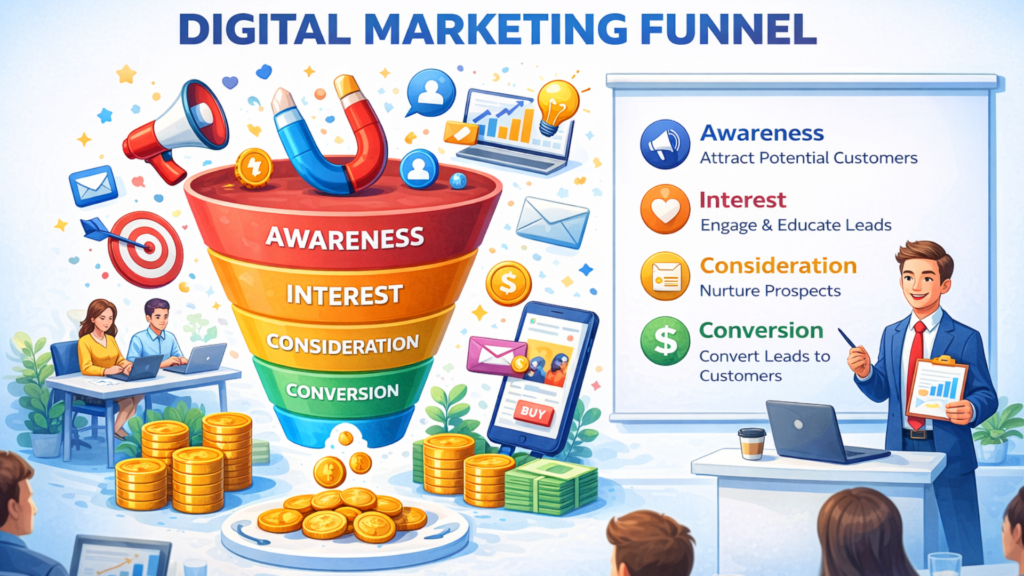
A Digital Marketing Funnel is a strategic model that represents the journey a potential customer goes through—from first discovering your brand to becoming a loyal customer. This Digital Marketing Funnel helps businesses understand how people move from awareness to purchase, and what marketing actions are needed at each step to guide them effectively.
The term Digital Marketing Funnel is used because, at the top, you attract a large audience, but only a smaller portion of them progress through each stage and ultimately convert into customers.
Understanding the Concept
Imagine a user browsing the internet. At first, they may not even know your brand exists. Over time, through ads, content, or social media, they begin to recognize your brand, consider your offerings, and eventually make a purchase decision.
This entire journey is structured and optimized using a digital marketing funnel.
Main Stages of a Digital Marketing Funnel
- Awareness Stage (TOFU, or Top of Funnel)
This is the first stage where potential customers find out about your business.
What Happens Here:
- Users realize they have a problem or need
- They start searching for information
- For the first time, they encounter your brand.
Marketing Activities:
- Search Engine Optimization (SEO)
- Blog posts and articles
- Social media marketing
- Video marketing
- Paid ads (Google Ads, Facebook Ads)
Goal:
- Attract a large audience
- Increase visibility
- Educate potential customers
Customers are now aware of your brand and are considering whether or not to use your products or services.
What Happens Here:
- Users compare different solutions
- They seek more detailed information
- They engage with your content
Marketing Activities:
- Email marketing campaigns
- Lead magnets (ebooks, webinars, free guides)
- Case studies and testimonials
- Product demos and explainer videos
- Retargeting ads
Goal:
- Build trust and credibility
- Generate leads
- Nurture potential customers
3. Bottom of Funnel, or BOFU, Stage of Decision and Conversion
At this moment, customers decide to take action and become customers.
What Happens Here:
- Users are ready to buy
- They evaluate final options
- They need reassurance and incentives
Marketing Activities:
- Special offers and discounts
- Strong Call-to-Action (CTA)
- Landing page optimization
- Free trials or consultations
- Customer reviews and ratings
Goal:
- Convert leads into customers
- Increase sales
4. Retention & Loyalty Stage (Post-Funnel)
After conversion, the journey doesn’t end. Maintaining customer involvement and promoting repeat business are the objectives of this stage.
What Happens Here:
- Customers evaluate their experience
- They may return for repeat purchases
- They can recommend your brand to others
Marketing Activities:
- Email follow-ups
- Customer support and engagement
- Loyalty programs
- Upselling and cross-selling
Goal:
- Increase customer lifetime value
- Build brand loyalty
Why is a Digital Marketing Funnel Important?
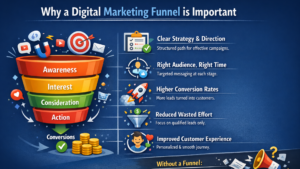
The following reasons make a digital marketing funnel crucial:
- Provides a clear structure for marketing strategies
- aids in concentrating on the right audience at the right time.
- Improves conversion rates
- Reduces wasted marketing efforts
- Enhances customer experience
Businesses frequently suffer with haphazard marketing initiatives that don’t yield regular results in the absence of a funnel.
Real-Life Example of a Digital Marketing Funnel
Suppose someone looks up “best fitness programs online”:
- They find your blog (Awareness)
- They download a free fitness guide (Consideration)
- They enroll in your paid program (Conversion).
- They renew their subscription and refer friends (Retention)
This is a great example of how a funnel works in the real world.
Tools Used to Optimize the Funnel

These kinds of tools are used by marketers to track and improve funnel performance:
- Google Analytics: for tracking website activity and traffic
- HubSpot – for lead nurturing and automation
- Mailchimp – for email campaigns
- For keyword research and SEO optimization, use SEMrush.
Key Metrics in a Digital Marketing Funnel
To measure success, businesses track:
- Website traffic (TOFU)
- Lead generation rate (MOFU)
- Conversion rate (BOFU)
- Customer retention rate
- Return on Investment (ROI)
Common Mistakes to Avoid
- Ignoring lead nurturing
- Focusing only on sales, not relationships
- Poor targeting of audience
- Weak content strategy
- Not analyzing data
Stages of the Digital Marketing Funnel

Usually, there are three primary steps to the funnel:
1. Top of the Funnel (TOFU) – Awareness
At this stage, your goal is to attract attention and make people aware of your brand.
Key Strategies:
- Search Engine Optimization (SEO)
- Social Media Marketing
- Content Marketing (blogs, videos, infographics)
- Paid Ads (Google Ads, Facebook Ads)
Example:
A user searches for “best digital marketing tips” and finds your blog through Google.
Goal:
- Increase website traffic
- Build brand awareness
- Educate your audience
2. Middle of the Funnel (MOFU) – Consideration
Here, potential customers are aware of your brand and are evaluating whether your product or service meets their needs.
Key Strategies:
- Email marketing campaigns
- Lead magnets (ebooks, webinars, free trials)
- Case studies and testimonials
- Retargeting ads
Example:
A visitor downloads your free ebook or subscribes to your newsletter.
Goal:
- Generate leads
- Build trust and credibility
- Nurture relationships
3. Bottom of the Funnel (BOFU) – Conversion
This is the stage where leads turn into customers. You want to motivate them to do something.
Key Strategies:
- Personalized offers
- Discounts and promotions
- Strong call-to-action (CTA)
- Landing page optimization
Example:
A user signs up for your service or makes a purchase.
Goal:
- Increase conversions
- Drive sales
Post-Purchase Stage – Retention & Loyalty
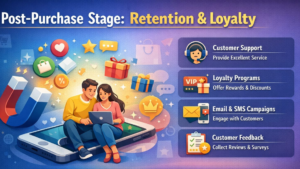
Many marketers overlook this stage, but it’s just as important as the others.
Key Strategies:
- Customer support and engagement
- Loyalty programs
- Email follow-ups
- Upselling and cross-selling
Goal:
- Retain customers
- Increase lifetime value
- Encourage referrals
Why is the Digital Marketing Funnel Important?
A well-defined funnel helps businesses:
- Understand customer behavior
- Aim for the appropriate audience at the appropriate moment.
- Improve conversion rates
- Maximize return on investment (ROI)
Marketing initiatives may become dispersed and ineffectual in the absence of a funnel.
How to Build an Effective Digital Marketing Funnel
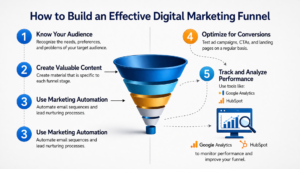
1. Know Your Audience
Recognize the needs, preferences, and problems of your target audience.
2. Create Valuable Content
Create material that is specific to each funnel stage.
3. Use Marketing Automation
Automate email sequences and lead nurturing processes.
4. Optimize for Conversions
Test ad campaigns, CTAs, and landing pages on a regular basis.
5. Track and Analyze Performance
Use tools like:
- Google Analytics
- HubSpot
to monitor performance and improve your funnel.
Common Mistakes to Avoid
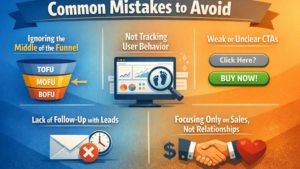
- Ignoring the middle of the funnel
- Not tracking user behavior
- Weak or unclear CTAs
- Lack of follow-up with leads
- Focusing only on sales, not relationships
1. Ignoring the Middle of the Funnel (MOFU)
Many businesses focus heavily on attracting traffic (TOFU) and closing sales (BOFU), but neglect the consideration stage.
Why It’s a Problem:
Potential customers are not always ready to buy immediately. Without nurturing, they lose interest or choose competitors.
What to Do Instead:
- Create valuable content like case studies, webinars, and email sequences
- Use retargeting ads to stay visible
- Build trust through consistent engagement
2. Not Understanding Your Target Audience
If you don’t clearly define your audience, your marketing efforts will miss the mark.
Why It’s a Problem:
- Irrelevant messaging
- Low engagement
- Poor conversion rates
What to Do Instead:
- Conduct audience research
- Create detailed buyer personas
- Understand customer pain points and needs
3. Weak or Unclear Call-to-Action (CTA)
A strong CTA is essential to guide users to the next step in the funnel.
Why It’s a Problem:
Users may not know what action to take, leading to lost opportunities.
What to Do Instead:
- Use clear, action-oriented language (e.g., “Get Started,” “Download Now”)
- Place CTAs strategically on pages
- Test different CTA variations
4. Focusing Only on Sales, Not Relationships
Many businesses push for immediate sales instead of building trust.
Why It’s a Problem:
Customers are less likely to buy from brands they don’t trust.
What to Do Instead:
- Provide value through content
- Engage with your audience regularly
- Build long-term relationships
5. Lack of Lead Nurturing
Capturing leads is only the beginning. Without nurturing, leads go cold.
Why It’s a Problem:
You lose potential customers who were initially interested.
What to Do Instead:
- Use email marketing campaigns
- Share personalized content
- Follow up consistently
6. Not Tracking and Analyzing Data
Many businesses fail to measure their funnel performance.
Why It’s a Problem:
Without data, you cannot identify what’s working or what needs improvement.
What to Do Instead:
Use tools like:
- Google Analytics
- HubSpot
to monitor traffic, user behavior, and conversions.
7. Poor Content Strategy
At each point of the funnel, content is essential.
Why It’s a Problem:
- Irrelevant or low-quality content reduces engagement
- Users drop off before converting
What to Do Instead:
- Create stage-specific content (TOFU, MOFU, BOFU)
- Focus on solving user problems
- Maintain consistency and quality
8. Ignoring Mobile Optimization
Mobile devices are used by a significant percentage of consumers to access content.
Why It’s a Problem:
- Poor user experience
- High bounce rates
- Lost conversions
What to Do Instead:
- Ensure your website is mobile-friendly
- Optimize loading speed
- Use responsive design
9. Overcomplicating the Funnel
Some businesses create overly complex funnels with too many steps.
Why It’s a Problem:
- Confuses users
- Increases drop-off rates
What to Do Instead:
- Keep the funnel simple and clear
- Minimize unnecessary steps
- Focus on user experience
10. Lack of Follow-Up
Failing to follow up with leads or customers is a major mistake.
Why It’s a Problem:
You miss opportunities for conversions and repeat business.
What to Do Instead:
- Send follow-up emails
- Offer additional value
- Re-engage inactive users
Conclusion
A digital marketing funnel is an essential framework that helps businesses turn potential customers into loyal buyers through a structured and strategic journey. From creating awareness to nurturing leads, driving conversions, and building long-term relationships, each stage plays a vital role in achieving marketing success.
By understanding your audience, delivering valuable content, and optimizing each step of the funnel, businesses can improve engagement, increase conversions, and maximize return on investment. In today’s competitive digital world, a well-designed and continuously optimized marketing funnel is key to sustainable growth and long-term success.
AUTHOUR: BASIL SHAJI