
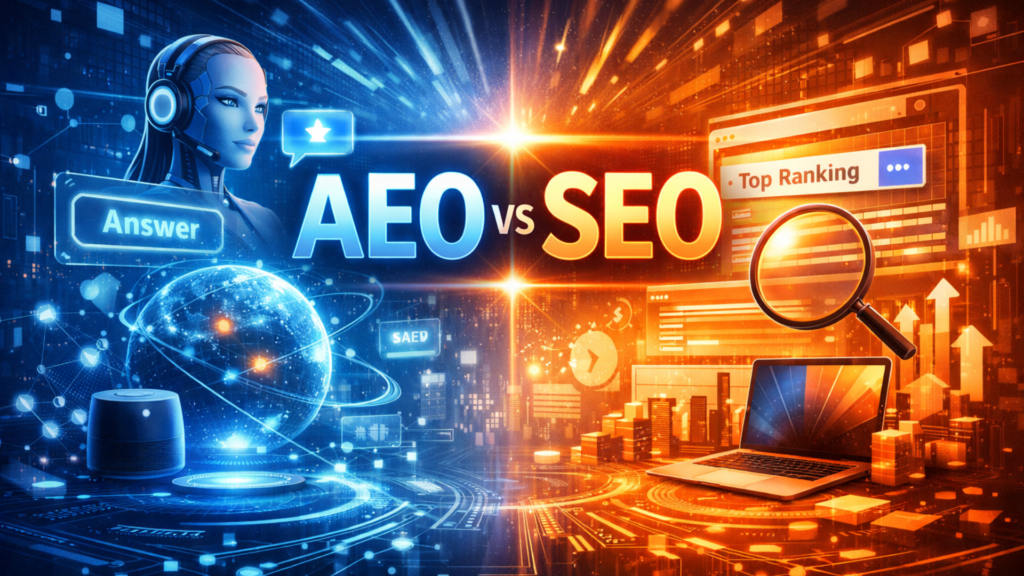
In today’s rapidly evolving digital landscape, businesses must stay ahead of changing search behaviors to remain competitive. While Search Engine Optimization (SEO) has long been the cornerstone of online visibility, a new concept is gaining traction—Answer Engine Optimization (AEO). As users increasingly rely on voice assistants, AI tools, and instant answers, understanding the difference between AEO and SEO is essential for modern digital marketing success.
This blog explores AEO vs SEO, their differences, benefits, and how businesses can leverage both strategies effectively.
What is SEO?
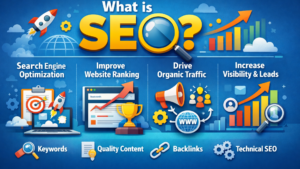
Search Engine Optimization (SEO) is the process of improving a website’s visibility in search engine results (like Google, Bing, and Yahoo) so that it attracts more organic (non-paid) traffic.
When users search for something online—such as “best digital marketing agency” or “how to learn SEO”—search engines display a list of relevant websites. SEO helps your website appear higher in those results, increasing the chances that users will visit your site.
How Search Engines Work
To truly understand SEO, it’s important to first know how search engines operate, especially when comparing AEO vs SEO in today’s evolving digital landscape. Search engines like Google follow three essential steps: crawling, indexing, and ranking. Crawling is the first stage, where search engine bots (also known as spiders) scan websites across the internet to discover new or updated content. These bots move from page to page using links, collecting data along the way. Once the content is discovered, it moves to the second stage called indexing.
In this process, the collected information is stored in a massive database known as an index, which acts like a digital library for quick retrieval. The final step is ranking. When a user enters a query, search engines analyze the indexed content and rank web pages based on factors such as relevance, quality, user experience, and authority. In the context of AEO vs SEO, while traditional SEO focuses on improving rankings to drive traffic, AEO emphasizes delivering direct, concise answers that satisfy user intent instantly. Understanding how search engines work helps businesses optimize their content effectively for both approaches, ensuring better visibility, higher engagement, and improved search performance
Key SEO Elements Explained
Keywords

Keywords are the words or phrases users type into search engines.
Types of Keywords:
- Short-tail (e.g., “SEO”)
- Long-tail (e.g., “best SEO services in Kochi”)
Using the right keywords helps search engines understand your content.
Content
Content is the foundation of SEO.
Good SEO Content Should Be:
Informative
Relevant
Original
Engaging
Updated regularly
High-quality material that responds to user inquiries is given priority by search engines.
Backlinks
Links linking to your website from other websites are known as backlinks.
High-quality backlinks = higher authority
Low-quality backlinks = can harm rankings
User Experience (UX)
Users’ interactions with your website are taken into account by search engines.
Important UX Signals:
Page load speed
Mobile responsiveness
Easy navigation
Low bounce rate
How SEO Works in Real Life
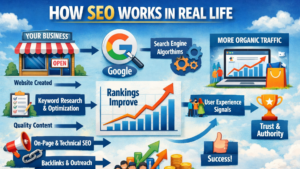
Let’s say you own a digital marketing business.
If someone searches:
- “SEO services in Kochi”
- “best digital marketing agency”
SEO helps your website:
- Appear on the first page
- Get more clicks
- Generate leads
SEO vs Paid Advertising
SEO Paid Ads
Free traffic Paid traffic
Long-term results Instant results
Builds authority Stops when budget ends
Higher trust Lower trust
Both strategies can work together, but SEO is essential for sustainable growth.
Latest SEO Trends
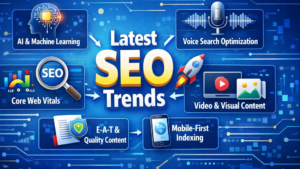
SEO is constantly evolving. Some current trends include:
1. Voice Search Optimization
People are using voice assistants more, so content must be conversational.
2. AI and Search Engines
Search engines are becoming smarter with AI-driven results.
3. Mobile-First Indexing
Search engines prioritize mobile-friendly websites.
4. User Intent Focus
Understanding what users actually want is more important than keywords alone.
Common SEO Mistakes to Avoid
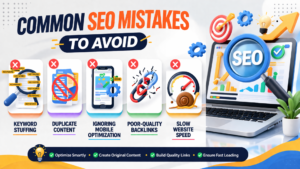
- Keyword stuffing
- Duplicate content
- Ignoring mobile optimization
- Poor-quality backlinks
- Slow website speed
Avoiding these mistakes helps maintain strong rankings.
What is AEO? (Answer Engine Optimization)
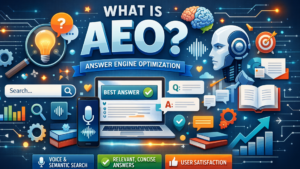
Answer Engine Optimization (AEO) is the process of optimizing content so that it provides direct, clear, and accurate answers to user queries—often without requiring users to click on a website. In the context of AEO vs SEO, AEO represents the shift from traditional ranking-based strategies to answer-focused optimization.
Unlike traditional SEO, which focuses on ranking web pages, AEO is designed to make your content the best possible answer for search engines, AI tools, and voice assistants like Google Assistant, Amazon Alexa, and Apple Siri.
How AEO Works
AEO works by aligning your content with how modern search systems deliver information.
1. Understanding User Questions
Users are now searching in a more natural, conversational way:
- “What is digital marketing?”
- “How does SEO work?”
- “Best way to improve website ranking?”
AEO focuses on answering these questions directly.
2. Structured Content
Search engines prefer content that is:
- Clear
- Concise
- Well-structured
This helps them extract answers quickly.
3. AI & Answer Engines
Modern platforms like Google and Microsoft Bing use AI to generate instant answers.
Instead of showing only links, they now display:
- Featured snippets
- Knowledge panels
- AI-generated summaries
AEO helps your content get selected for these positions.
Where AEO Appears
AEO-optimized content can appear in multiple places:
- 1. Featured Snippets (Position Zero)
These are succinct responses that appear at the top of search results.
- Voice Search Results
When a user asks a question, voice assistants read the best response.
- “People Also Ask” Sections
These sections offer brief responses to relevant queries.
- AI Search Results
AI-powered tools summarize content and present direct answers.
Key Elements of AEO
-
Question-Based Content
AEO focuses heavily on questions and answers.
Example:
Question: What is SEO?
Answer: A short, clear definition in 2–3 sentences
-
Concise Answers
Answers should be:
Direct
Easy to understand
Typically 40–60 words for snippets
-
Structured Formatting
Use formats that are easy for search engines to read:
Bullet points
Numbered lists
Tables
Short paragraphs
-
Schema Markup (Structured Data)
Schema markup improves the way search engines comprehend your material.
Common Types:
FAQ schema
How-to schema
Article schema
5. Authority & Trust
Search engines prefer content that is:
- Accurate
- Reliable
- From trusted sources
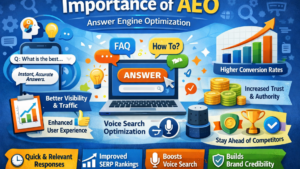
Importance of AEO
Benefits of AEO
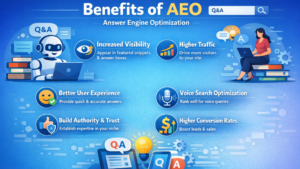
1. Increased Visibility
Search results may show your material at the top.
2. Authority Building
Being selected as the answer builds trust and credibility.
3. Voice Search Optimization
AEO guarantees that your content is compatible with voice assistants.
4. Competitive Advantage
Early adoption of AEO gives you an edge over competitors.
AEO vs Traditional SEO
| Feature | SEO | AEO |
| Goal | Rank pages | Provide answers |
| Focus | Keywords | Questions |
| Content | Long-form | Short + structured |
| Results | Website clicks | Direct answers |
| Platforms | Search engines | AI + voice assistants |
Both tactics are crucial and ought to be applied in tandem.
How to Optimize for AEO
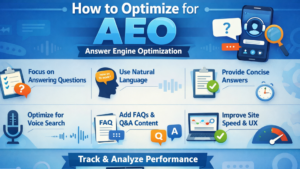
Optimizing for Answer Engine Optimization (AEO) requires a strategic approach focused on delivering clear and direct answers to user queries. In the context of AEO vs SEO, this approach highlights the shift from traditional ranking strategies to answer-focused content optimization. The first step is to identify common questions by using research tools and understanding what your audience is actively searching for Once identified, it is important to provide immediate answers at the beginning of your content, ensuring clarity and relevance.
Writing in simple, conversational language helps improve readability and aligns with how users interact with voice search and AI tools. Additionally, including FAQ sections allows you to address multiple related questions in a structured way. To increase visibility, content should be optimized for featured snippets by using definitions, bullet points, and step-by-step instructions.
Implementing schema markup further helps search engines understand your content better. Finally, maintaining high-quality content that is accurate, valuable, and user-focused is essential for successful AEO performance. 🚀
Real-Life Example of AEO
Search query:
👉 “What is AEO?”
AEO-Optimized Answer:
“Search engines and voice assistants frequently use Answer Engine Optimization (AEO), which is the process of optimizing content to provide direct answers to user queries.”
This type of answer is:
- Short
- Clear
- Easily extractable
Common AEO Mistakes to Avoid
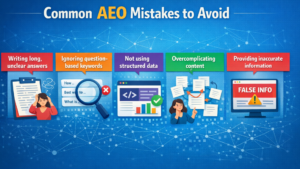
- Writing long, unclear answers
- Ignoring question-based keywords
- Not using structured data
- Overcomplicating content
- Providing inaccurate information
Future of AEO
The future of digital marketing is being shaped by AEO.
Trends:
- Growth of AI-powered search
- Increased voice search usage
- More zero-click results
- Greater focus on user intent
Companies who embrace AEO will remain competitive in the digital arena.
Best Strategy: Combine AEO + SEO
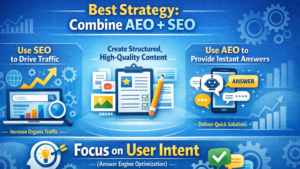
To succeed online:
- Use SEO to drive traffic
- Use AEO to provide instant answers
- Create structured, high-quality content
- Focus on user intent
This hybrid approach ensures maximum visibility and engagement.
Key Differences Between AEO and SEO
1. Focus
- SEO: Focuses on ranking web pages
- AEO: Focuses on delivering direct answers
Whereas AEO focuses on accuracy and relevance, SEO is about visibility.
2. User Intent
- SEO: Focuses on a variety of search intentions
- AEO: Focuses on question-based queries
AEO prioritizes conversational and natural language queries like:
- “What is digital marketing?”
- “How does SEO work?”
3. Content Format
- SEO Content: Long-form blogs, articles, landing pages
- AEO Content: Short, clear, structured answers
AEO content often includes:
- FAQs
- Bullet points
- Step-by-step guides
- Structured data (schema markup)
4. Search Results Appearance
- SEO: Blue links in SERPs
- AEO: Featured snippets, voice answers, AI summaries
AEO helps your content appear in:
- Position zero (featured snippets)
- Voice assistant responses
- AI-generated answers
5. Click Behavior
- SEO: Encourages users to click your website
- AEO: May provide answers without clicks
This is known as zero-click searches, where users get information instantly.
Why AEO is Becoming Important
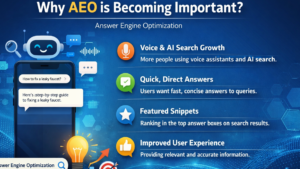
With the rise of AI and voice search, user behavior is changing dramatically. People want quick, precise answers instead of browsing multiple websites.
Key Trends Driving AEO:
- Growth of voice assistants
- Increase in mobile searches
- Rise of AI-powered search engines
- Demand for instant information
Businesses that adapt to AEO can gain a competitive advantage by becoming the primary source of answers.
Benefits of SEO
Advantages:
- Drives consistent organic traffic
- Builds brand authority
- Improves website visibility
- Supports lead generation
- Works for all industries
SEO is still essential for attracting users and building an online presence.
Benefits of AEO
Advantages:
- Positions your brand as an authority
- Increases chances of featured snippets
- Optimizes for voice search
- Improves user experience
- Captures zero-click traffic
AEO ensures your content is accessible in modern search environments.
How to Optimize for SEO
To succeed with SEO, focus on:
1. Keyword Optimization
Use relevant keywords naturally in your content.
2. High-Quality Content
Create informative, engaging, and valuable content.
3. Technical Improvements
Ensure fast loading speed and mobile responsiveness.
4. Backlink Building
Gain links from trusted websites.
5. User Experience
Improve navigation and readability.
How to Optimize for AEO
To succeed with AEO, adopt a different approach:
1. Answer Questions Clearly
Provide direct, concise answers to common queries.
2. Use Structured Data
Implement schema markup to help search engines understand content.
3. Create FAQ Sections
Answer multiple related questions in one place.
4. Optimize for Voice Search
Use conversational language and long-tail keywords.
5. Focus on Featured Snippets
Format content to appear in:
- Lists
- Tables
- Short paragraphs
SEO vs AEO: Which One Should You Choose?
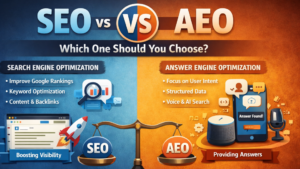
SEO vs AEO: Which One Should You Choose?
When it comes to AEO vs SEO, the answer is simple—you need both. In the ongoing discussion of AEO vs SEO, it’s important to understand that these are not competing strategies but complementary ones that work best together in modern digital marketing. SEO is primarily focused on driving organic traffic, helping your website rank for competitive keywords, and building long-term authority in search engine results.
It ensures that your content is discoverable and attracts users to your website. On the other hand, AEO is designed to answer user queries directly, optimize content for voice search, and secure featured snippets or instant answers on search engines. In the evolving landscape of AEO vs SEO, businesses that combine both approaches can maximize their visibility across all search platforms. While SEO brings users to your site, AEO ensures your content is delivered instantly when users seek quick answers. Ultimately, adopting a balanced AEO vs SEO strategy is the key to improving reach, enhancing user experience, and achieving long-term digital success.
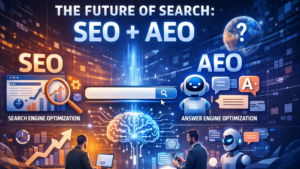
Future of Search: SEO + AEO
Conclusion
In the ever-evolving world of digital marketing, both SEO and AEO play crucial roles in ensuring online visibility and success. While SEO helps businesses rank higher on search engines and drive consistent organic traffic, AEO focuses on delivering quick, precise answers that meet modern user expectations.
As search behavior shifts toward voice search, AI-driven results, and instant information, relying on SEO alone is no longer enough. Businesses must adapt by incorporating AEO strategies to stay relevant and competitive.
The key to long-term success lies in combining both approaches—using SEO to attract users and AEO to provide immediate value. By creating high-quality, structured, and user-focused content, businesses can maximize their reach, build authority, and stay ahead in the future of search.
AUTHOR: BASIL SHAJI