

One of the most effective and economical digital marketing techniques is still email marketing. Email still offers a high return on investment, direct contact, and individualized audience interaction despite the growth of social media and other channels.
This site will teach you about email marketing, its advantages, tactics, and how to use it successfully for business expansion.
What is Email Marketing?
Email marketing is a digital marketing strategy that involves sending targeted emails to a group of people to promote products or services, share valuable content, and build long-term relationships with customers. It is one of the most effective ways for businesses to communicate directly with their audience in a personalized, measurable, and cost-efficient manner.
Unlike other marketing channels, email allows businesses to reach users in their personal inbox—making it a powerful tool for engagement, lead nurturing, and conversions.
Understanding Email Marketing
At its core, email marketing is about delivering the right message to the right person at the right time.
For example, when someone signs up on your website, they may receive:
- A welcome email
- A series of educational emails
- Promotional offers
- Follow-ups based on their actions
This structured communication helps guide users through the customer journey—from awareness to purchase and beyond.
How Email Marketing Works
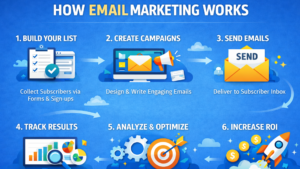
Email marketing follows a simple but strategic process:
1. Building an Email List
Businesses collect email addresses through:
- Website sign-up forms
- Landing pages
- Lead magnets (ebooks, discounts, free trials)
2. Audience Segmentation
Subscribers are divided into groups based on:
- Interests
- Behavior
- Purchase history
- Demographics
This ensures more relevant and targeted communication.
3. Creating and Sending Emails
Businesses create engaging emails that include:
- A compelling subject line
- Valuable content
- Clear call-to-action (CTA)
Emails can be sent manually or automated using tools.
4. Automation and Personalization
With automation, businesses can send emails based on user actions, such as:
- Welcome emails after signup
- Abandoned cart reminders
- Product recommendations
Personalization includes using the user’s name, preferences, and behavior to make emails more relevant.
5. Tracking Performance
Marketers analyze results using metrics like:
- Open rate
- Click-through rate (CTR)
- Conversion rate
Tools like Mailchimp and HubSpot help track and optimize campaigns.
Types of Email Marketing
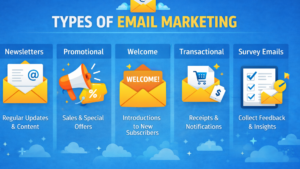
1. Promotional Emails
Used to promote products, services, or offers.
2. Informational Emails
Provide valuable content like newsletters, updates, and blogs.
3. Transactional Emails
Triggered by user actions (order confirmations, receipts, etc.).
4. Lead Nurturing Emails
Designed to guide potential customers through the buying journey.
Key Features of Email Marketing
- Direct Communication: Reach customers personally in their inbox
- Personalization: Customize messages based on user data
- Automation: Save time with scheduled and triggered emails
- Measurable Results: Track performance easily
- Scalability: Reach a large audience at low cost
Benefits of Email Marketing
Email marketing offers several advantages:
- High return on investment (ROI)
- Strong customer relationships
- Increased brand awareness
- Better customer retention
- Higher conversion rates
It is especially effective because it targets users who have already shown interest in your business.
Real-Life Example
Imagine a user visits an online store and signs up for a newsletter:
- They receive a welcome email
- They get product recommendations
- They receive a discount offer
- They make a purchase
- They receive follow-up emails and loyalty rewards
This is how email marketing works in practice.
Why Email Marketing Still Matters
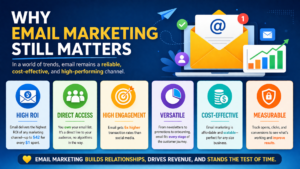
Even with the growth of social media, email marketing remains relevant because:
- It provides direct access to your audience
- It is not controlled by algorithms
- It allows personalized communication
- It delivers consistent and measurable results
Why is Email Marketing Important?
Email marketing is one of the most essential and powerful tools in digital marketing. It plays a crucial role in helping businesses connect with their audience, build relationships, and drive consistent revenue. Email is very beneficial for long-term growth since it offers direct, individualized, and quantifiable communication, unlike many other marketing platforms.
1. Direct Communication with Your Audience
Email marketing allows businesses to communicate directly with customers in their inbox.
Why This Matters:
- No dependency on social media algorithms
- Messages reach users personally
- Higher chances of engagement
Unlike platforms where visibility is limited, email ensures your message is delivered directly to your audience.
2. High Return on Investment (ROI)
Email marketing consistently delivers one of the highest ROI among all digital marketing channels.
Why This Matters:
- Low cost compared to paid advertising
- High conversion potential
- Scalable for businesses of all sizes
Even small businesses can achieve strong results with minimal investment.
3. Personalization and Targeting
Email marketing allows you to send personalized messages based on user behavior, interests, and preferences.
Why This Matters:
- Increases engagement and open rates
- Builds stronger connections with customers
- Improves conversion rates
Businesses may segment audiences and provide customized content by using technologies like HubSpot and Mailchimp.
4. Builds Strong Customer Relationships
Email marketing helps businesses nurture relationships over time.
Why This Matters:
- Keeps your audience engaged
- Builds trust and credibility
- Encourages repeat purchases
Regular communication through newsletters and updates strengthens brand loyalty.
5. Supports the Entire Customer Journey
Email marketing is effective at every stage of the marketing funnel.
How It Helps:
- Awareness: Welcome emails introduce your brand
- Consideration: Educational emails provide value
- Conversion: Offers and promotions drive sales
- Retention: Follow-ups and loyalty emails keep customers engaged
It acts as a bridge between different stages of the customer journey.
6. Automation Saves Time and Effort
Email marketing can be automated, allowing businesses to send messages at the right time without manual effort.
Why This Matters:
- Improves efficiency
- Ensures timely communication
- Enables scalable marketing
Examples include:
- Welcome emails
- Abandoned cart reminders
- Birthday or anniversary emails
7. Measurable and Data-Driven
Email marketing provides detailed insights into performance.
Key Metrics:
- Open rate
- Click-through rate (CTR)
- Conversion rate
- Bounce rate
These insights help businesses improve their campaigns continuously.
8. Increases Brand Awareness
Consistent email communication keeps your brand top-of-mind.
Why This Matters:
- Reinforces brand identity
- Builds familiarity
- Encourages customer recall
Even if users don’t convert immediately, they remember your brand.
9. Drives Website Traffic
Emails can direct users to your website, blog, or landing pages.
Why This Matters:
- Increases traffic
- Promotes content
- Improves engagement
Strategic CTAs can guide users to take desired actions.
10. Improves Customer Retention
Email marketing is one of the best tools for retaining customers.
Why This Matters:
- Encourages repeat purchases
- Builds loyalty
- Increases customer lifetime value
Retaining existing clients is frequently more economical than bringing in new ones.
11. Cost-Effective Marketing Channel
Compared to paid ads, email marketing is highly affordable.
Why This Matters:
- Minimal investment required
- Suitable for startups and small businesses
- High scalability
You can reach thousands of users at a very low cost.
12. Full Control Over Your Audience
Your email list is an owned asset, in contrast to social media sites.
Why This Matters:
- No risk of losing audience due to platform changes
- Direct access to subscribers anytime
- Greater control over communication
Types of Email Marketing
1. Promotional Emails
These emails are used to promote products, services, discounts, or special offers.
Examples:
- Sale announcements
- Product launches
- Limited-time offers
2. Informational Emails
These emails provide value and keep your audience informed.
Examples:
- Newsletters
- Blog updates
- Company news
3. Transactional Emails
These are triggered by user actions.
Examples:
- Order confirmations
- Password resets
- Shipping updates
4. Lead Nurturing Emails
These emails guide potential customers through the buying journey.
Examples:
- Welcome series
- Educational content
- Follow-up emails
Benefits of Email Marketing
- Cost-Effective: Low investment with high returns
- Personalization: Tailor messages based on user behavior
- Automation: Send emails automatically using tools
- Measurable Outcomes: Monitor clicks, conversions, and open rates
- Customer Retention: Keep customers engaged and loyal
Essential Elements of an Effective Email Marketing Campaign
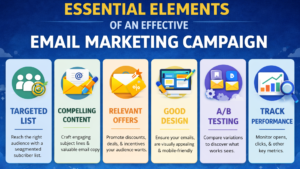
1. Email List
Build a high-quality email list with people genuinely interested in your business.
2. Subject Line
A compelling subject line increases open rates.
3. Content
Provide valuable, relevant, and engaging content.
4. Call-to-Action (CTA)
Guide readers to take action (buy, subscribe, download).
5. Design
Use clean, mobile-friendly, and visually appealing designs.
Email Marketing Strategy
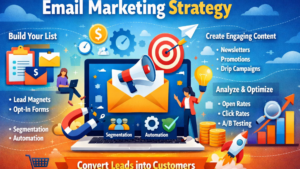
1. Build Your Email List
- Use sign-up forms on your website
- Offer lead magnets (ebooks, discounts, free trials)
2. Segment Your Audience
Divide your audience based on:
- Interests
- Behavior
- Demographics
3. Personalize Your Emails
Use names, preferences, and behavior to customize messages.
4. Automate Campaigns
Use tools to send emails at the right time automatically.
5. Test and Optimize
Conduct A/B testing on CTAs, content, and subject lines.
Tools for Email Marketing
Some popular tools include:
- Mailchimp
- HubSpot
- ConvertKit
- ActiveCampaign
These tools help automate campaigns, segment audiences, and track performance.
Key Metrics to Track
To measure success, focus on:
- Open Rate
- Click-Through Rate (CTR)
- Conversion Rate
- Bounce Rate
- Unsubscribe Rate
Common Mistakes to Avoid
- Sending too many emails
- Ignoring personalization
- Weak subject lines
- Not optimizing for mobile
- Buying email lists
Best Practices for Email Marketing
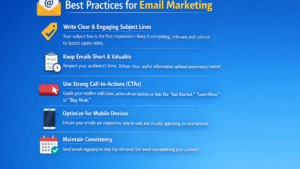
- Write clear and engaging subject lines
- Keep emails short and valuable
- Use strong CTAs
- Optimize for mobile devices
- Maintain consistency in sending emails
Conclusion
Email marketing continues to be one of the most powerful and reliable digital marketing strategies for businesses of all sizes. From building awareness to nurturing leads, driving conversions, and maintaining long-term customer relationships, it plays a vital role across the entire customer journey.
What makes email marketing truly effective is its ability to deliver personalized, targeted, and measurable communication directly to your audience. When combined with the right strategy—such as audience segmentation, automation, and valuable content—it can significantly improve engagement, boost conversions, and maximize return on investment.
However, success in email marketing requires more than just sending emails. It involves understanding your audience, avoiding common mistakes, continuously analyzing performance, and optimizing campaigns over time. Businesses that focus on delivering value and building trust will stand out in crowded inboxes.
In today’s competitive digital landscape, email marketing is not just an option—it is a necessity. When executed effectively, it becomes a powerful tool for sustainable growth, stronger customer relationships, and long-term business success.
AUTHOR : BASIL SHAJI
Hi, this is a comment.
To get started with moderating, editing, and deleting comments, please visit the Comments screen in the dashboard.
Commenter avatars come from Gravatar.